Shortwave Radio
Listening beyond the horizon.
Listen beyond the horizon
Shortwave radio carries voices, music, news and digital signals across countries and continents. This guide helps new listeners understand propagation, choose useful frequencies and explore the bands with the live K5NWZ receiver.
Good Shortwave Signals to Try
These links open the live K5NWZ receiver at useful starting points. Shortwave is live radio, so a signal may be weak, fading, or absent when you arrive.
WWV broadcasts from Fort Collins, close to Loveland, but propagation can carry the signal over a nearby receiver. Different frequencies can arrive at different strengths as conditions change.
FT8 is one of the most consistently active weak-signal modes. The decoder may show callsigns when stations are transmitting.
Tune FT8 on 20 m ↗The 40-meter band often offers useful activity across daytime and nighttime. Start with the FT8 portion of the band.
Tune FT8 on 40 m ↗These profiles are already set for AM. International broadcast bands do not work equally well all day: the lower 49 m and 41 m bands often improve after sunset, while 25 m and 22 m are more likely to work in daylight. The 31 m band can be useful around the transitions. Solar activity, season, and the ionosphere all matter, so a quiet band usually means propagation is poor—not that the receiver or link is broken.
BEGINNER’S PROPAGATION GUIDE
The band you choose matters as much as the station
Propagation simply means the way a radio signal travels from the transmitter to your receiver. Shortwave signals can bend back toward Earth from electrically charged layers high in the atmosphere called the ionosphere. Sunlight changes those layers, so a frequency that works well at noon may be quiet after sunset—and a band that sounds dead in the afternoon may come alive at night.
Morning through afternoon
Begin with 20 meters for amateur activity or the 31-, 25- and 22-meter broadcast bands. Strong sunlight can absorb lower-frequency signals while supporting higher frequencies over long distances.
Evening and nighttime
Try 40 meters for amateur signals and the 41- and 49-meter broadcast bands. After dark, the lower bands often carry farther and sound busier.
Sunrise and sunset
These transition periods can be especially interesting. Conditions change quickly, so compare 31, 41 and 49 meters instead of staying on one quiet frequency.
A simple first-listen plan
- Daylight: open the 20m amateur, 31m broadcast or 25m broadcast profile.
- After sunset: open the 40m amateur, 41m broadcast or 49m broadcast profile.
- Listen and look: scan slowly and click visible signals on the waterfall.
- Nothing there? Change bands before deciding the receiver or antenna is not working.
Remember: these are reliable starting points, not guarantees. Season, distance, solar activity, storms, transmitter schedules and antenna conditions all affect what you will hear.
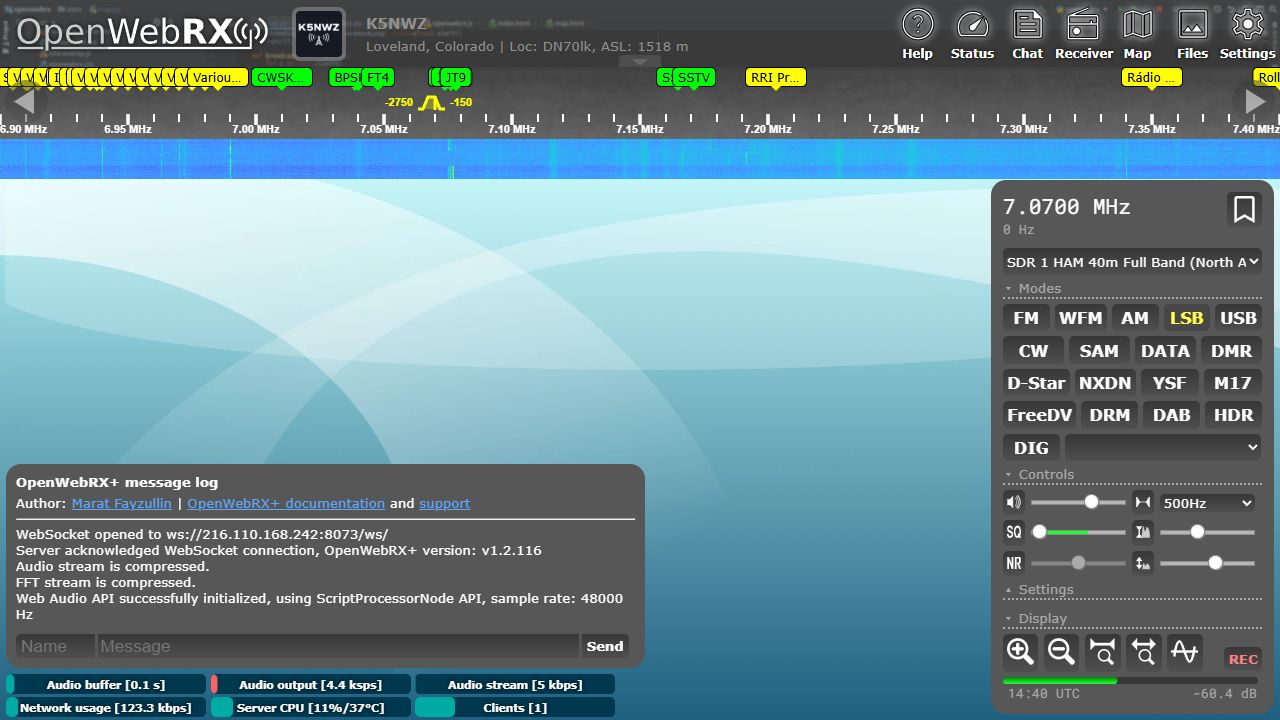
A Real K5NWZ Shortwave Waterfall
Shortwave radio is one of the most fascinating parts of the radio spectrum. Unlike local broadcast stations that are limited to a city or region, shortwave signals can travel thousands of miles by bouncing off layers of the Earth’s ionosphere. Because of this unique propagation, it is possible to hear radio stations from other countries and continents using nothing more than a simple receiver and a modest antenna.
For decades, shortwave has been used for international broadcasting, maritime communications, aviation, military operations, and amateur radio. Many countries have operated powerful shortwave transmitters to broadcast news, culture, and information around the world. Even today, you can tune across the bands and hear stations from Europe, Asia, Africa, and South America depending on the time of day and current propagation conditions.
One of the most intriguing aspects of shortwave listening is the mysterious Numbers Stations. These stations transmit sequences of numbers, letters, or coded messages that often sound unusual or even eerie. They may use synthesized voices, mechanical speech, tones, or musical introductions before the message begins. While their exact purpose is rarely officially confirmed, they are widely believed to be used for intelligence communications, sending encrypted messages to agents operating in other countries.
Numbers stations have been heard on shortwave for many decades and continue to appear on the air today. For shortwave listeners, discovering one of these broadcasts can be an unforgettable experience and adds an element of mystery to the hobby.
Shortwave listening is also a hobby that is very easy and inexpensive to get started with. Many modern receivers and software defined radios can tune the shortwave bands, and often a simple wire antenna is enough to begin hearing signals from around the world.
Whether you are interested in international broadcasting, aviation communications, amateur radio activity, digital signals, or the mysterious world of numbers stations, shortwave radio offers an incredible opportunity to explore global communications from your own home. It remains one of the most rewarding ways to experience radio and discover just how far signals can travel through the atmosphere.
What should I try tonight?
A practical starter log for signals worth hunting. Times are shown in UTC—the common clock used by shortwave listeners everywhere.
| Station / service | Frequency | When to try | From | What you may hear | SDR bookmark |
|---|---|---|---|---|---|
| WWVBest local first catch | 2.500 · 5.000 · 10.000 · 15.000 · 20.000 MHz 25.000 MHz experimental | 24 hours 15/20 MHz day · 5/10 MHz night | Fort Collins, Colorado | Atomic time ticks, voice announcements, propagation and geophysical information. | LISTEN ↗WWV 10 MHz · AM |
| WWVHListen for the female voice | 2.500 · 5.000 · 10.000 · 15.000 MHz | 24 hours Often easier toward the Pacific | Kekaha, Kauai, Hawaii | Time ticks and announcements sharing frequencies with WWV. | LISTEN ↗WWVH / WWV shared channel · AM |
| WRMI — Radio Miami InternationalMany programs, one transmitter site | 5.050 · 5.850 · 5.955 · 7.730 · 7.780 · 9.390 · 9.455 · 9.950 · 15.770 MHz | Schedule varies by program Try lower channels after dark | Okeechobee, Florida, USA | Talk, music, religious, cultural and relay programming from many producers. | LISTEN ↗WRMI 9.955 MHz · AM |
| Radio Exterior de EspañaSpanish international service | 9.690 · 11.685 · 17.715 · 17.855 MHz | Evening UTC; seasonal schedule Frequencies can rotate | Noblejas, Spain | News, culture, sports and Spanish-language programming. | LISTEN ↗REE 17.855 MHz · AM |
| Radio Romania InternationalEuropean signal-hunting favorite | 9.500 · 9.740 · 11.750 · 11.850 MHz | Scheduled UTC broadcasts Check several listed channels | Țigănești / Galbeni, Romania | News, Romanian culture, music and multilingual programs. | LISTEN ↗RRI 11.750 MHz · AM |
| Radio New Zealand PacificLong-distance challenge | 7.390 · 9.650 · 11.725 · 13.655 · 15.720 · 17.675 MHz | Frequency changes through the UTC day Higher by day, lower by night | Rangitaiki, New Zealand | Pacific news, music and regional programming; a rewarding North American catch. | LISTEN ↗RNZ 13.655 MHz · AM |
| Shannon VOLMETAviation weather | 5.505 · 8.957 · 13.264 MHz USB | 24 hours Choose by propagation | Shannon, Ireland | Recorded aviation weather reports for North Atlantic airports. | LISTEN ↗Shannon 8.957 MHz · USB |
| New York VOLMETNorth Atlantic aviation weather | 3.485 · 6.604 · 10.051 · 13.270 MHz USB | 24 hours Lower at night, higher by day | New York, USA | Terminal forecasts and weather reports in a repeating aviation broadcast. | LISTEN ↗New York 10.051 MHz · USB |
Listen from this page
Explore Shortwave on the Live K5NWZ SDR
The K5NWZ receiver covers the major shortwave broadcast bands, amateur HF bands and WWV time stations. Open the receiver in another tab, choose one of the recommended profiles above, and watch the real waterfall while you listen.
Read and listen only · Shared receiver · Another visitor may change the profile