Get started in amateur radio
Do not wait for the perfect radio, antenna, or technical background. Get the license, decide what you want radio to do, assemble a simple first station, and learn by getting on the air.
Your first five moves
Start studying now
Use the current Technician question pool and take practice exams repeatedly.
Schedule the exam
A date creates momentum. In-person and remote exam sessions are available.
Choose one first goal
Local repeaters, mobile use, digital radio, emergency work, outdoor operation, or HF.
Build a simple station
One radio, one useful antenna, safe power, and a way to program the radio.
Meet other operators
Visit clubs, join the Discord, ask questions, and get help with the first contact.
Get the license first
The Technician license is much easier to earn than many newcomers expect. You do not need to know Morse code, build a radio, or master electronic theory before taking the test. The quickest path is to work through the current question pool and take practice exams repeatedly. The same kinds of questions will become familiar, and many people begin by memorizing the correct answers. When you consistently score about 90 percent on practice tests, schedule the real 35-question exam.
You will still encounter questions about safety, operating rules, antennas, electricity, and radio basics, but you do not have to understand every technical detail before becoming licensed. Passing the exam gets you through the door. Once you are in the hobby, operating radios, experimenting with antennas, asking questions, and working with other amateurs will turn those memorized answers into real understanding. The license is the beginning of the education—not the finish line.
Practice until the exam feels familiar
K5NWZ Technician Practice Tests
Start here with the current question pool, realistic 35-question exams, quick practice sessions, missed-answer review and scores saved on this device.
ARRL study material
Use the official current question pool, licensing explanations, books, classes, and exam information.
Find the exam
Choose an in-person local session or a remote online session. Confirm what identification and FCC registration information the exam team requires.
What do you want radio to do?
Talk around town
Start with a VHF/UHF handheld or mobile radio and learn the local repeaters. This is usually the least expensive entry.
Operate from a vehicle
A mobile radio, outside antenna, and safe fused power provide much more useful range than a handheld inside a vehicle.
Reach beyond the region
HF is the path toward state, national, and international contacts. It requires different radios, antennas, and usually a General-class license for broad privileges.
Explore digital systems
DMR, Fusion, D-STAR, packet, APRS, Winlink, FT8, and other systems each solve different communication problems.
Go outdoors
Parks, summits, camping, off-roading, and emergency deployments reward portable equipment and antennas that can be erected quickly.
Listen before transmitting
Use the K5NWZ SDR to hear signals, see the waterfall, and learn what activity sounds like before buying equipment.
Start inexpensive, but buy for the job
| Goal | Simple starting point | What improves it most |
|---|---|---|
| Local repeaters | Basic dual-band handheld such as a Baofeng UV-5R or a better-supported alternative from an established amateur-radio manufacturer | An outside antenna, correct programming, and local help |
| Vehicle and wider local coverage | Dual-band mobile radio with a fused power connection | A properly mounted external antenna and good coax |
| Home VHF/UHF station | Mobile radio used as a base station with a suitable regulated power supply | An outdoor antenna placed safely and as high as practical |
| HF and long-distance radio | Used or entry-level HF transceiver chosen after defining bands, modes, space, and antenna options | The antenna and installation—not simply a more expensive radio |
Important: owning a radio capable of transmitting on a frequency does not authorize its use there. Program and operate it only within the privileges of your license and the applicable service rules.
A better antenna usually beats a more expensive radio
Handheld antenna
A quality antenna matched to the correct band can help, but the operator’s location still matters greatly.
Vehicle magnet mount
A simple magnetic-mount antenna on a metal vehicle roof gives the antenna a useful ground plane and gets the signal outside the vehicle.
Indoor metal ground plane
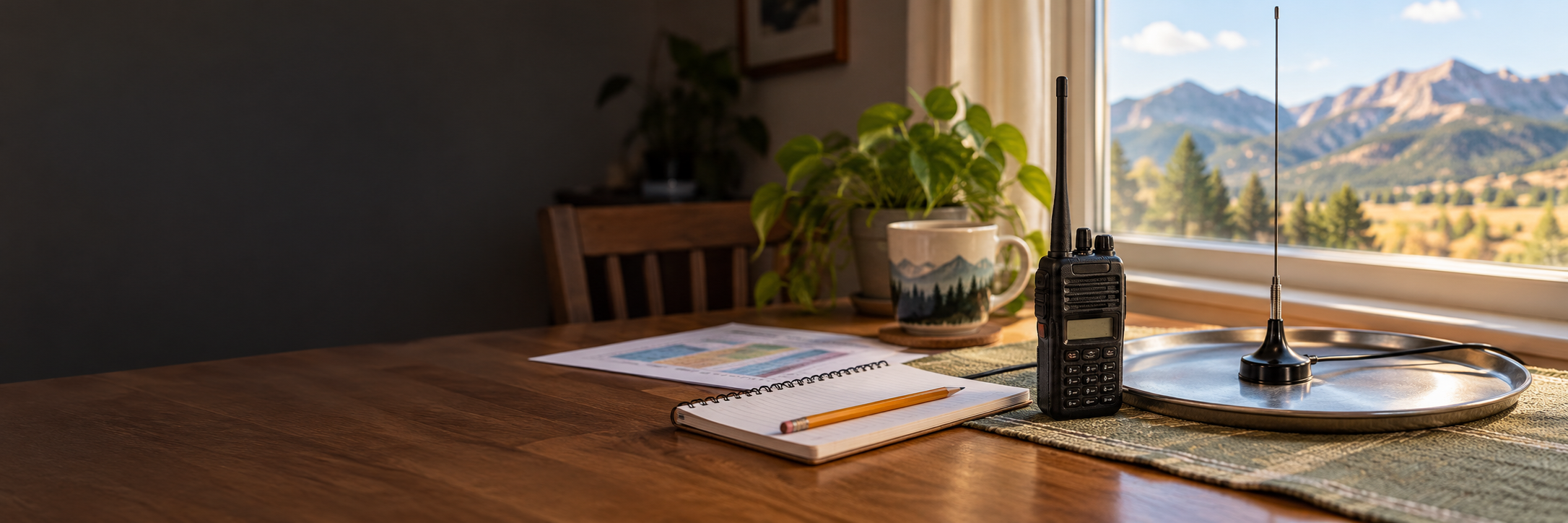
A magnetic-mount antenna can be placed on a large steel baking sheet or similar metal surface for experimentation inside the shack. Keep it clear of people and electronics while transmitting.
Outdoor base antenna
Height, clear surroundings, correct coax, weatherproofing, grounding, and safe separation from power lines all matter.
Turn the radio into something useful
Use CHIRP when supported
CHIRP is free, open-source programming software that supports many popular radios. Confirm that your exact radio and cable are supported before connecting.
Set up EchoLink after licensing
Once your callsign appears in the FCC database, register with EchoLink, complete its amateur-license validation, and receive your EchoLink node number. The phone and computer apps let you connect through participating stations, repeaters, and conferences over the internet—even before you own a radio.
It is an easy, inexpensive way to practice using your callsign, meet other operators, and explore linked systems. EchoLink is internet-assisted amateur communication rather than a direct over-the-air contact from your device.
Load nearby repeaters
You need the receive frequency, transmit frequency or offset, and correct tone or code. The local directory explains those fields for newcomers.
Listen, then identify
Listen before transmitting. When the channel is clear, say your callsign and that you are a new operator looking for a radio check.
Where to find affordable equipment
Visit local clubs and find an Elmer
Do not try to figure out everything alone. Visit more than one local club, meet active operators, and look for an experienced mentor—traditionally called an Elmer in amateur radio.
A good Elmer can help you choose equipment that fits your goals, program your first radio, improve an antenna, make your first contact, and avoid common purchasing and operating mistakes. That guidance can save you a great deal of time, frustration, and money.
Hamfests and swap meets
These are excellent places to handle equipment, compare prices, meet other operators, and find a genuinely good deal. Sellers will sometimes offer a newcomer an especially generous price because they want to help somebody enter the hobby.
Bring a trusted friend who is an active, licensed amateur-radio operator. They can help you recognize equipment that fits your goals and steer you away from radios that are obsolete, heavily modified, unsupported, difficult to program, or simply too complicated for a first station. A bargain is only a bargain if the equipment works and you can realistically use it.
Established used dealers
A tested radio with a return policy can be worth more than an unknown bargain.
Private sales
Ask what is included, whether the radio transmits properly, whether it has been modified, and whether accessories are original and safe.
Meet operators on the K5NWZ Discord
Come introduce yourself, say what interests you, ask about study tools, compare first radios and antennas, and find out which local clubs and activities people enjoy. It is also a good place to ask for help programming a radio or making that first contact.
Look for the events that make radio real
Club meetings, license classes, testing sessions, Field Day, Winter Field Day, public-service events, Parks on the Air, Summits on the Air, contests, swap meets, and hamfests all give a newcomer a reason to operate and people to operate with.
Do these things now
- Open the K5NWZ Technician Practice Tests and take your first Quick 10.
- Use the current 2026–2030 Technician pool.
- Take an initial practice test, even if the score is low.
- Study and retest until you repeatedly score around 90 percent.
- Choose and schedule an exam session.
- Visit at least one club and join the K5NWZ Discord.
- Write down your first operating goal before buying equipment.
This guide will continue to expand with dedicated antenna recommendations, first-radio comparisons, local events, hamfests, Field Day information, and practical station-building examples.