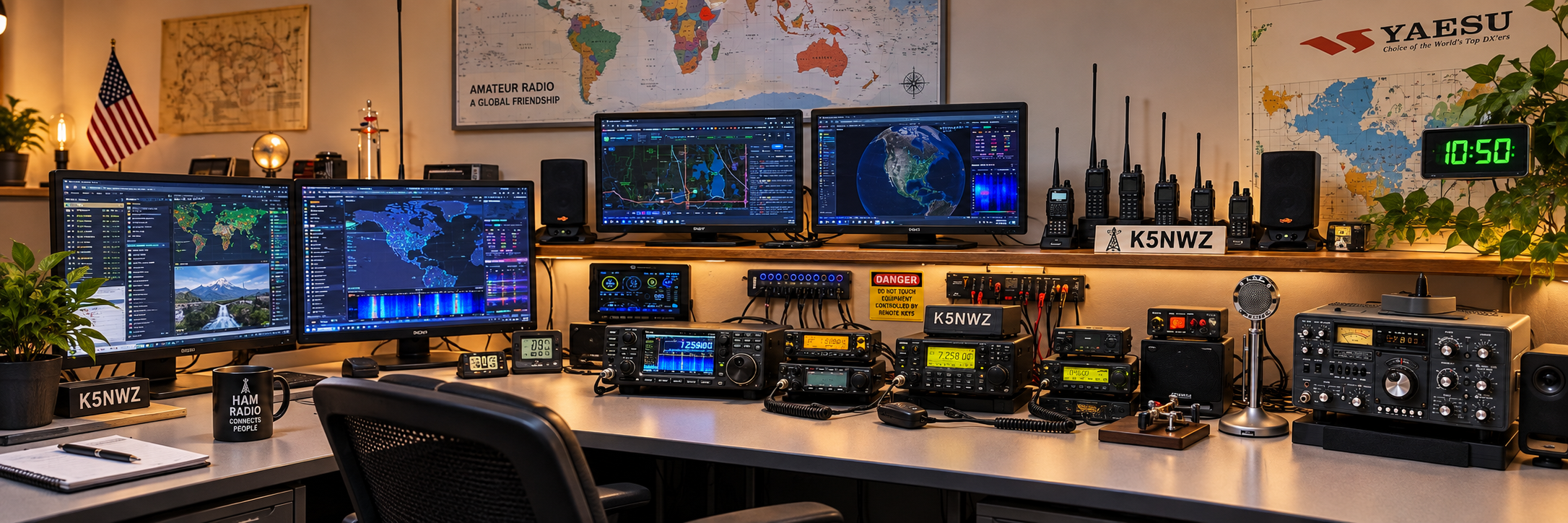
Amateur Radio
More than a century of experimentation—now open to anyone curious enough to begin.
From sparks and Morse code to repeaters, satellites, digital modes and worldwide contacts
Amateur radio—usually called ham radio—is a licensed radio service built around learning, experimentation, communication and public service. You can talk across town through a repeater, send digital messages, track stations on a map, bounce signals through satellites or reach another continent with a wire antenna. You do not need an engineering degree, an expensive station or a lifetime of experience to start.
What makes amateur radio different?
It lets ordinary people legally build, modify and operate radio equipment across many bands and modes. Unlike a phone, the radio path is the point: you learn why the signal works, improve it and communicate without depending entirely on commercial networks.
Radio began with a spark
In the late 1800s, scientists learned that electrical energy could create waves that traveled through space. Early experimenters—including Heinrich Hertz, Nikola Tesla, Guglielmo Marconi and many others—turned laboratory demonstrations into practical wireless communication. Marconi’s systems used high-voltage sparks to create bursts of radio energy. A telegraph key switched those bursts on and off to spell messages in Morse code.


Morse code turned dots and dashes into letters long before voice radio was practical. It remains useful because a narrow, weak signal can travel surprisingly far and be copied in difficult conditions. You can still learn and use Morse code today, but the United States no longer requires a Morse test for any amateur license.
Milestones: from telegraph wire to the digital airwaves
Samuel Morse and other inventors develop practical electrical telegraph systems. Dots and dashes carry language over wire and establish the operating rhythm later used by radio.
James Clerk Maxwell predicts that electromagnetic waves can travel through space—providing the theory behind radio.
Heinrich Hertz demonstrates electromagnetic waves in the laboratory and confirms Maxwell’s prediction.
Guglielmo Marconi develops increasingly practical wireless telegraph equipment and demonstrates communication over growing distances.
Marconi reports reception of the Morse letter S across the Atlantic, a celebrated moment showing the potential of long-distance wireless.
The U.S. Radio Act requires station licensing and government-assigned callsigns. Amateurs are pushed to shorter wavelengths that commercial interests considered less valuable.
The American Radio Relay League is organized to help amateurs relay messages beyond the range of a single station.
Amateurs demonstrate that shortwave signals can span great distances through the ionosphere, helping transform radio engineering and international communication.
The transistor, postwar surplus equipment and single-sideband voice make stations smaller and more capable. FM and VHF/UHF activity grow.
OSCAR 1, the first amateur-radio satellite, reaches orbit. Amateur space communication becomes a lasting part of the hobby.
Local FM repeaters spread while packet radio connects radios to computers, moving callsigns, messages and data over the air.
The entry path changes: the U.S. introduces a no-code Technician route in 1990, and by 2007 Morse proficiency is no longer required for any U.S. amateur license.
APRS, internet-linked voice systems, software-defined radio and powerful personal-computer software connect radio with mapping, networking and digital signal processing.
FT8 appears and makes reliable weak-signal digital contacts possible in short, synchronized exchanges—even when signals are difficult to hear.
Voice and Morse share the bands with satellites, digital voice, images, packet, Winlink, FT8 and remote stations—while a homemade wire antenna can still reach the world.
Hardware through the decades
Radio gear did not simply become smaller. Each generation changed what an ordinary operator could do—from hand-built high-voltage transmitters, to large vacuum-tube stations, rugged field radios, compact solid-state transceivers, computer-linked packet stations and today’s software-defined shack. The archival examples show the broader technical progression; the K5NWZ family photographs make that history personal.

Sparks, coils and open wiring
This complete amateur station pairs a spark-gap transmitter with a crystal receiver, telegraph key and antenna switch. It shows what a working hobby station looked like—not merely one component on a bench. Public-domain source ↗

Early mobile radio
A complete transmitting and receiving station could be fitted to a car—but “portable” still meant exposed hardware, a substantial antenna and plenty of mechanical ingenuity. Public-domain source ↗

The home station takes shape
Station 8XK shows the early amateur model: separate equipment, homemade antennas and an operating position assembled by an experimenter rather than purchased as one appliance. Public-domain source ↗

Rugged wartime field sets
The 1944 SCR-694 represents the durable, self-contained field equipment that trained thousands of radio operators and strongly influenced postwar amateur practice. U.S. Army public-domain source ↗

The vacuum-tube era
This is my grandfather’s Bates Radio and Television repair shop in Inglewood, California. It connects the history of tube-era radio directly to my own family and to the practical skill of keeping early electronics working.

Skills passed from one bench to another
My grandfather is on the left and my father, then a young man, is on the right. The photograph captures how radio knowledge was often passed directly through families—from troubleshooting and soldering to understanding what was happening inside the cabinet.

A family built around radio
My mother and father stand in front of the family’s radio and television repair shop after my father left the Air Force. The image marks the period when radio, television and increasingly solid-state electronics became part of everyday American life.

Radios meet personal computers
This is me operating ARRL Field Day from a cabin in the Big Thicket in Texas. By this era, the station combined modern transceivers with computer logging and digital tools, while portable antennas and field operating skills remained essential.
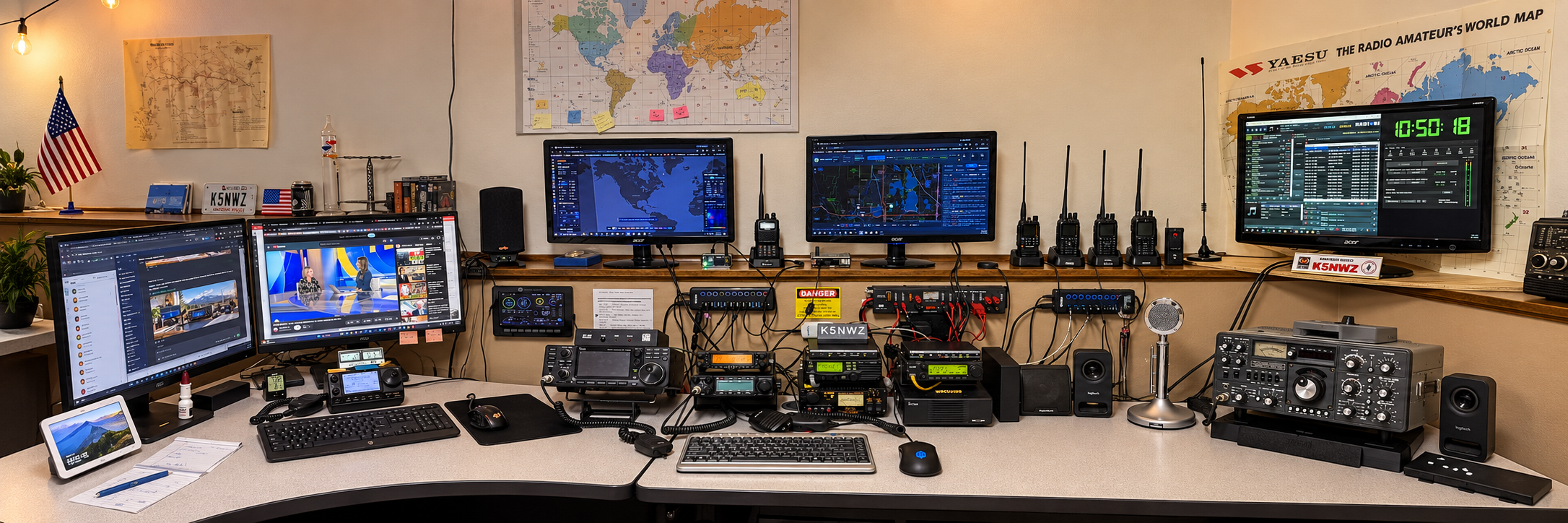
The radio becomes software
This is the current K5NWZ station—or at least part of it. Modern transceivers now share the shack with SDR waterfalls, maps, decoding software, remote control and networked data, while the fundamentals of antennas and propagation remain unchanged.
WWV: the sound of precise time from Fort Collins
The station that fascinated me as a boy
As a young boy, I used to tune across the shortwave bands until I found WWV. The steady ticks, tones and calm voice announcing the exact time seemed almost mysterious: an invisible signal carrying a national standard through the air. Knowing that this remarkable station now broadcasts from just north of Fort Collins makes it an especially meaningful part of radio history for me.
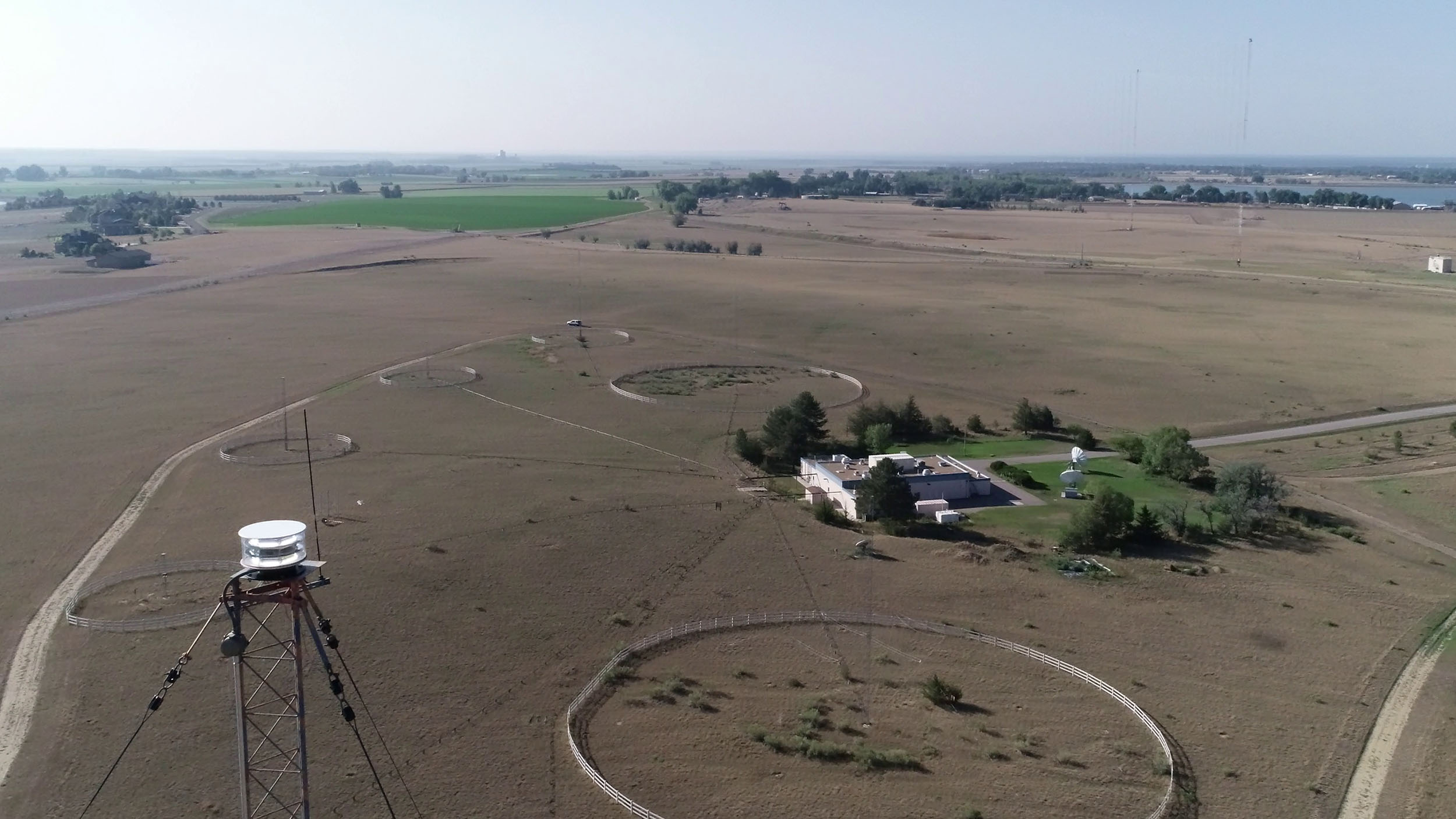
WWV is operated by the National Institute of Standards and Technology. Its call letters were assigned in 1919, experimental broadcasts began in Washington, D.C., in 1920, and regular standard-frequency service followed in 1923. The station later operated from several Maryland locations. At 0000 UTC on December 1, 1966, the Maryland transmitters were shut down as the present Fort Collins facility came on the air. Over time, WWV progressed from frequency calibration to telegraphic time in 1945, spoken time in 1950, geophysical alerts in 1957, a digital time code in 1960 and today’s coordinated scientific services.
What you hear
Each minute contains precise ticks, standard audio tones and a male-voice announcement of Coordinated Universal Time. The signal also carries a digital time code, UT1 corrections and geophysical information. Since 2021, special test signals have supported ionospheric research with NIST and HamSCI.
Five shortwave channels
WWV transmits continuously on 2.5, 5, 10, 15 and 20 MHz. The 5, 10 and 15 MHz transmitters run 10 kW; 2.5 and 20 MHz use 2.5 kW. Multiple frequencies matter because the ionosphere changes with time of day, season and solar conditions.
A remarkable antenna farm
Every frequency has its own transmitter and half-wave vertical antenna. The 2.5 MHz structure is about 60 meters tall, while the 20 MHz antenna is about 7.5 meters. Nine sloping quarter-wave wires form the lower half of each antenna and also serve as guys. The rigid coaxial feed lines were deliberately laid out so none cross.
Why amateurs still listen: WWV is both a precise reference and a propagation beacon. Which WWV frequency is strongest can tell you something about current HF conditions, while the tones and carrier help check receivers, frequency accuracy and station timing.
Listen to the ticks, tones and UTC announcement
This public-domain off-air recording captures WWV as heard on shortwave. It includes the familiar voice announcement, precise ticks and standard tones. Light shortwave noise is part of the real listening experience.
Authentic off-air WWV recording; public-domain NIST broadcast. Recording details and timeline ↗
Listen to WWV Live Right Now
This is the actual WWV shortwave broadcast—not a recording. The K5NWZ receiver can tune the Fort Collins time station so you can hear its live ticks, tones and UTC announcements as they arrive over the air.
Once the receiver opens
- Click Receiver at the top of the OpenWebRX screen.
- Open the saved-profile list.
- Select any profile whose name begins SDR 1 TIME – Standard Time Stations / WWV.
- Listen for the once-per-second ticks and the spoken UTC announcement near the end of each minute.
Which profile should you try? Start with WWV 10 MHz. If it is weak, try 5 MHz at night or 15 and 20 MHz during daylight. The 2.5 MHz profile is another nighttime option. Shortwave propagation changes constantly, so one frequency may be much clearer than another.
Saved choices: WWV 2.5 MHz · WWV 5 MHz · WWV 10 MHz · WWV 15 MHz · WWV 20 MHz — all labeled Fort Collins.
Callsigns: your radio identity
Every licensed amateur station identifies with a government-issued callsign. In the United States, a callsign normally contains one or two prefix letters, a numeral and one to three suffix letters—such as K5NWZ. The number originally carried strong geographic meaning: the country was divided into call areas, and the numeral indicated the operator’s region.
The prefix
Letters such as K, N, W and AA–AL identify callsign blocks assigned to the United States under international agreements.
The number
The numeral points to a historic U.S. call area. Because operators move and may request vanity calls, it no longer guarantees where a station is physically located.
The suffix
The final letters distinguish one licensee from another. Vanity calls let eligible operators request an available combination with personal meaning.
A callsign identifies the licensed station; it is not a secret account name. Operators say it on the air at required intervals so everyone knows who is transmitting.
What can you actually do?
Local voice
Use a handheld or mobile radio directly, or through a repeater placed on a high site to extend local coverage.
Worldwide HF
Use the ionosphere to reach across states, oceans and continents with voice, Morse and digital modes.
Digital communication
Decode weak signals, exchange messages, report positions, send email over radio and connect computers to the airwaves.
Satellites and space
Make contacts through amateur satellites, receive telemetry and even communicate with the International Space Station when opportunities allow.
Public service
Train with local groups, support community events and develop disciplined emergency-communication skills.
Build and experiment
Construct antennas, interface radios with computers, test propagation, use SDRs and create systems commercial services were never designed to provide.
How repeaters make a small radio reach farther
A handheld radio may cover only a few miles in difficult terrain. A repeater listens on one frequency and retransmits what it hears on another, usually from a tower, mountain or tall building. Its height gives it a much larger radio horizon. Program the repeater’s receive frequency, offset and access tone correctly, identify with your callsign, and your modest handheld can join conversations across a wide area.
Getting licensed in the United States
You may listen to amateur radio without a license. To transmit on amateur frequencies, you need an FCC amateur operator license. There are currently three active license classes; each step grants broader privileges.
| LICENSE | WHAT IT OPENS | EXAM |
|---|---|---|
| Technician | The normal starting point: all amateur privileges above 30 MHz, including popular VHF/UHF repeaters, plus limited HF privileges. | 35 questions on rules, safety, basic electronics and operating practices. |
| General | Substantial operating privileges on every amateur band, making worldwide HF communication practical. | An additional 35-question written examination. |
| Amateur Extra | All available U.S. amateur operating privileges and the broadest access to HF frequency segments. | An additional 50-question examination. |
Listen first
Use a scanner, SDR or handheld in receive-only mode. Learn what repeaters and nets sound like.
Study
Use the published question pool, a study guide, videos or a local class. Morse code is not required.
Take the exam
Find an in-person or remote Volunteer Examiner session. Follow the current FCC application instructions.
Get on the air
Wait until your callsign appears in the FCC database, program the radio carefully and make a simple first contact.
See a real station
Where should a newcomer begin?
If you like talking
Start with the Technician license, a properly programmed VHF/UHF radio and a local repeater or club net. Listen, write down callsigns and learn the rhythm before joining in.
If you like computers
Explore SDR, FT8, APRS, packet radio, digital voice and radio-connected mapping. Modern amateur radio is full of software and data.
If you like building
Start with an antenna. Even a simple wire or homemade VHF antenna teaches more about radio than an expensive accessory bought without understanding.
If you like the outdoors
Try portable operating, Parks on the Air, satellite contacts and emergency-power experiments. Radio becomes especially interesting away from the grid.