ANTENNA IS CURRENTLY BEING UPGRADED AND RELOCATED. System is online but temporarily the antenna is at ground level until a new mast can be erected
Welcome to the K5NWZ Online SDR
Welcome to my online Software Defined Radio. This receiver allows you to tune across a wide range of frequencies right from your browser and experience real-world radio signals as they happen here in Northern Colorado.
Whether you are a licensed ham radio operator, a shortwave listener, or just curious about what’s out there, this is a great way to explore the radio spectrum. You can listen to amateur radio, aviation, public service, and more depending on conditions and band activity.
No special software is required. Just jump in, tune around, and see what you can find.
Keep in Mind
- There is a bit of a learning curve when using this SDR. I have set it up to strike a balance between simplicity and access to more advanced controls. Take your time exploring the different bands, modes, and settings. Don’t be afraid to experiment. You’re not going to break anything.
- It works on mobile devices, but you will have a much better experience using a desktop computer
- If you have questions, I encourage you to ask them on the K5NWZ-SDR Discord channel.
- While up to twenty users can be connected at the same time, the receiver can only tune to one signal at a time. If you notice the frequency changing unexpectedly, another user has likely taken control.
- There is also a built-in chat feature that allows you to communicate with other users. You can toggle the chat window on or off using the icon in the upper right corner.
- This SDR uses a wideband discone antenna designed to cover a broad range of frequencies. The tradeoff is reduced sensitivity compared to antennas tuned for specific bands.
- Keep propagation in mind. Higher frequency bands are affected by sunspot activity and ionospheric conditions. A band that is active at night may be quiet during the day, and vice versa.
- I would love to hear about your experience, good or bad, on the K5NWZ-SDR Discord channel. I built this to give anyone curious about radio a chance to explore and learn
Link to the K5NWZ – SDR
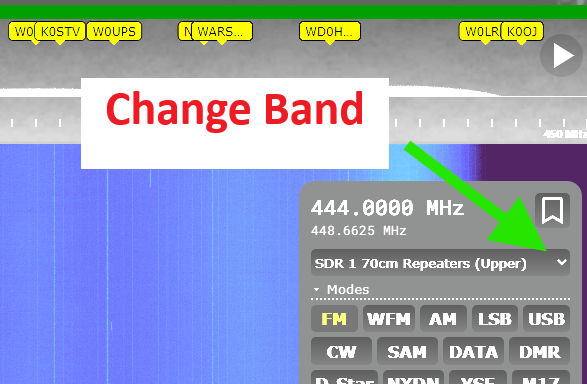
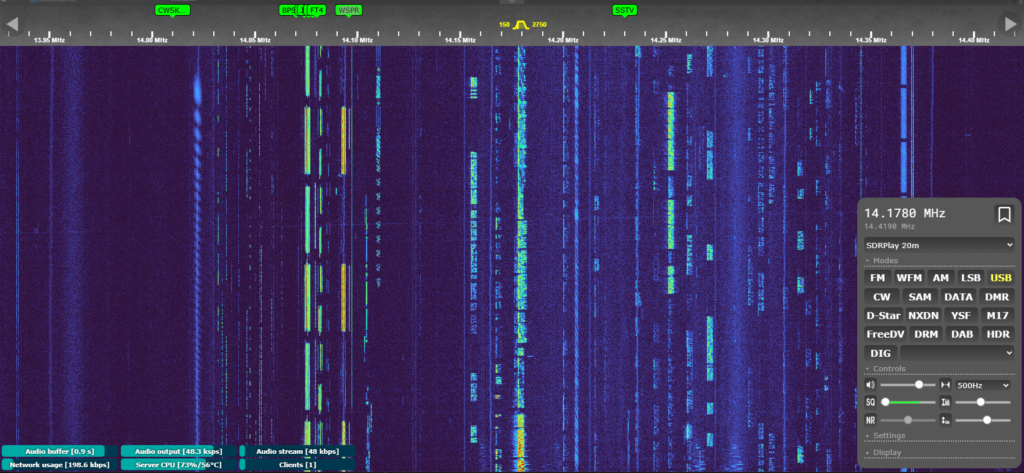
I will soon be putting my Software Defined Radio receiver online and making it publicly accessible. The goal is to give people a window into what is actually happening on the radio spectrum around us.
For those who are curious about radio but don’t yet have equipment or a license, you will be able to tune the bands directly from your browser and explore what is out there.
I am taking the time to preconfigure the receiver so it is easy to use. Bands, bookmarks, and receiver profiles will already be set up so visitors can simply click and start listening instead of trying to figure out complicated SDR settings. My goal is to make the experience smooth and enjoyable so new users don’t get discouraged.
For the Meshtastic and Meshcore community, the receiver will also allow you to see digital radio activity happening in real time. The system will display and decode signals such as:
• LoRa signals and bursts in the ISM bands
• Packet radio activity
• APRS transmissions and decoding
• Aircraft beaconing such as ADS-B
• Weather station data bursts
• Various other digital signals and telemetry
It is pretty fascinating to actually watch data appear out of the air as it is decoded.
My hope is that this sparks curiosity, especially for people who are not yet licensed hams, and maybe encourages a few to take the next step and earn their amateur radio license.
The link will be posted here once the receiver goes live.
Stay tuned. There is a lot happening in the air around us.
How to Use the K5NWZ SDR Receiver
Using the receiver will be very simple. It runs entirely in your web browser, so no special software or installation is required.
When you open the receiver page you will see a waterfall display showing the radio spectrum in real time. Signals appear as bright lines across the display, allowing you to visually see activity on the band.
To explore the spectrum you can:
• Click directly on a signal in the waterfall to tune it
• Use preset bookmarks to jump to interesting frequencies
• Change receiver modes such as AM, FM, or digital depending on the signal
• Zoom in and out to explore more of the band
Everything will be preconfigured with useful bookmarks and receiver profiles, making it easy for newcomers to start listening immediately.
The receiver is connected to an external wideband discone antenna, which is well known for excellent wide frequency coverage. This type of antenna allows the system to monitor large portions of the radio spectrum with good sensitivity, helping you hear signals from across Northern Colorado and beyond.
What You Can Listen For
The radio spectrum is full of activity, much of which most people never realize is happening around them every day. With the K5NWZ SDR receiver you may encounter signals such as:
• Amateur radio operators having conversations
• Digital data bursts from APRS and packet radio
• LoRa transmissions used by Meshtastic and other ISM devices
• Aircraft transponder signals and beaconing systems
• Weather station telemetry
• Shortwave broadcasts from around the world
• Various digital modes used by radio experimenters
One of the most interesting aspects of SDR is that you can watch signals appear visually on the waterfall display, making it easy to spot activity even before you tune to it.
What is Software Defined Radio?
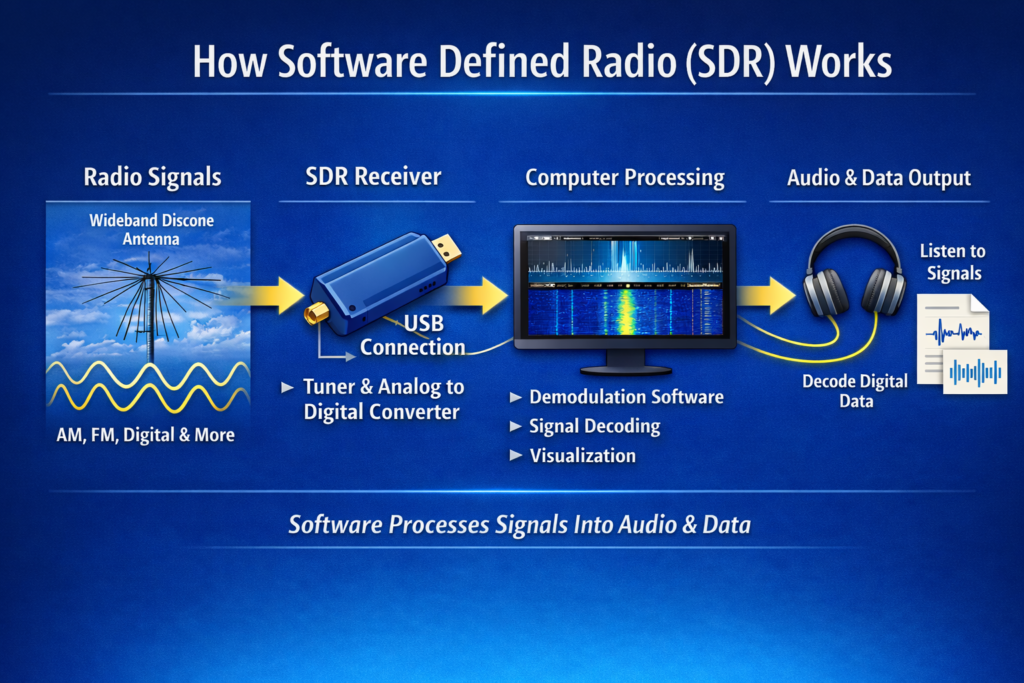
Software Defined Radio, commonly called SDR, has completely changed the way people explore the radio spectrum.
In traditional radios, most signal processing is performed by hardware circuits. In an SDR, much of that work is handled by software running on a computer. This allows a single inexpensive receiver to tune and decode a huge range of signals simply by changing software.
One of the most remarkable things about SDR is how inexpensive it is to get started. For the price of a modest antenna or a handheld radio battery, you can purchase a small USB receiver and begin exploring large portions of the radio spectrum. Many entry level SDR receivers cost between $30 and $50, making them one of the most affordable ways to get into radio experimentation.
These small receivers plug directly into a computer and work with a wide variety of free software applications. Instead of turning a dial like a traditional radio, you view the radio spectrum on your screen using a waterfall display that visually shows signals across an entire band. You can click on signals, tune them instantly, and watch activity across thousands or even millions of frequencies at once.
Despite their small size and low cost, SDR receivers are incredibly powerful tools.
With the right software you can:
• Monitor amateur radio bands
• Listen to aviation communications
• Track aircraft using ADS-B
• Decode weather satellite images
• Receive NOAA weather broadcasts
• Monitor public service communications where permitted
• Explore shortwave broadcasts from around the world
• Decode many amateur radio digital modes
• Observe the radio spectrum in real time
For amateur radio operators, SDR has opened the door to experimentation that previously required expensive equipment. It allows operators to visualize signals, analyze interference, monitor multiple frequencies at once, and decode many digital communication modes.
SDR is also widely used in education and research because it allows users to see radio signals as well as hear them, making it easier to understand how radio systems work.
Whether you are a licensed amateur radio operator, a shortwave listener, or simply curious about what signals are flying through the air around you, Software Defined Radio offers an incredibly powerful and affordable way to explore the radio spectrum.
In many cases, all you need to get started is a small SDR receiver, a simple antenna, and a computer. From there, the possibilities are almost endless.
Why Web Based SDR Receivers Are Changing Radio
Web based SDR receivers like the one hosted here on K5NWZ allow anyone with an internet connection to explore the radio spectrum from anywhere in the world.
Traditionally, listening to radio signals required buying equipment, installing antennas, and learning how to operate specialized hardware. While that is still part of the hobby for many people, web based SDR systems remove those barriers and allow people to start exploring radio immediately.
With a web based SDR you can:
• Tune across entire radio bands remotely
• Visually observe radio activity using waterfall displays
• Listen to signals from distant locations
• Learn about radio systems without owning equipment
• Experiment with different modes and frequencies
These systems have become incredibly popular for education, experimentation, and outreach because they make radio accessible to anyone who is curious.
For amateur radio operators, they also provide a way to share the hobby with the public and inspire the next generation of radio enthusiasts.
If exploring this receiver sparks your interest, you may find yourself going down one of the most fascinating technical rabbit holes there is.
The radio spectrum is full of signals, stories, and technology waiting to be discovered.
Think to keep in mind while operation my SDR
- There is a bit of a learning curve when using this SDR. I have set it up to strike a balance between simplicity and access to more advanced controls. Take your time exploring the different bands, modes, and settings. Don’t be afraid to experiment. You’re not going to break anything. If you have questions, I encourage you to ask them on the K5NWZ-SDR Discord channel.
- While up to twenty users can be connected at the same time, the receiver can only tune to one signal at a time. If you notice the frequency changing unexpectedly, another user has likely taken control.
- There is also a built-in chat feature that allows you to communicate with other users. You can toggle the chat window on or off using the icon in the upper right corner.
- This SDR uses a wideband discone antenna, designed to cover a broad range of frequencies. The tradeoff is reduced sensitivity compared to antennas tuned for specific bands.
- Keep propagation in mind. High Frequency (HF) bands are affected by sunspot activity and ionospheric conditions. A band that is active at night may be quiet during the day, and vice versa.
- I would love to hear about your experience, good or bad, on the K5NWZ-SDR Discord channel. I built this to give anyone curious about radio a chance to explore and learn.